Medical Research.
From clinical protocols
to structured decisions.
- What I’m researching
- AI-assisted conversion of clinical protocols into tables and block-schemes.
- My contribution
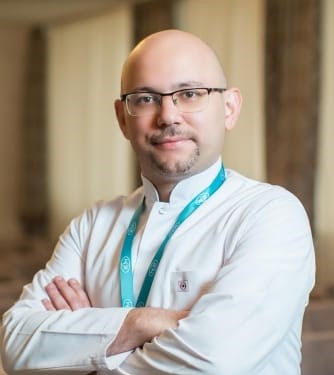
- Technical research and development, working with Dr. Murad’s medical expertise.
- Key challenge
- Identifying conditions and actions while preserving the original clinical logic.
- Current result
- Ongoing research with example block-schemes and a proposed hybrid architecture.
From a manual process
to a research question.
The idea for my research came from my experience working on a clinical decision support system. Until September 2025, I was part of a team working on this project at Turn, a company where I interned, and I saw how much time it took to turn clinical protocols into algorithms.
First, doctors studied the protocols and manually transferred the information into tables. Then, together with programmers, they created block-schemes showing which questions should be asked, what each answer meant, and what action should follow. After that, the block-schemes were transferred to another platform. Every stage required a lot of manual work and the involvement of several specialists.
Later, I asked Dr. Murad Miskarli to provide me with their side project, a first aid application for ordinary people, which they had not started programming yet. After receiving the necessary materials, I used existing AI tools to convert them into block-schemes in just one day. This result caught the attention of Dr. Murad. He asked if we could use the same method to process entire collections of clinical protocols.
This question became the starting point of our joint research. We are now working on the project together. Murad is a professional doctor, while I am a 17-year-old student in the 11th grade at Secondary School No. 8. He provides medical knowledge and helps check the accuracy of the connections, while I focus on the technical side of the project.
We are researching whether AI can be trained to correctly understand the text of medical protocols, identify conditions and actions, and then create tables and block-schemes while keeping the original logic.
I have recently started studying how artificial intelligence is developed so that I can use this knowledge in our project. My goal is to build my own AI system from scratch that can perform this task.
Our main idea is to create a hybrid system. Artificial intelligence would work within the limits of existing clinical protocols. To do this, I want to use Retrieval-Augmented Generation (RAG).
I understand that this is a large and challenging project, and I am still at the beginning of the process. At university, I want to continue our research, study AI development in greater depth, and develop my own platform to support medical diagnosis and treatment. My goal is to combine the abilities of artificial intelligence with the clear rules of clinical protocols and gradually turn our idea into a working hybrid system.
Example block-scheme.
This example block-scheme was made by doctors based on clinical protocols. It represents questions, connections, and actions in a structured form.
How hybrid system
schemes are created.
Explore the clinical sources, proposed hybrid architecture, and connected ecosystem through three illustrated steps.